General
We had good rain in the second half of October (45.3 mm), sufficient to turn the grass green but not heavy enough to fill watercourses and pans. We had large numbers of wildebeest throughout the month, certainly tens of thousands. At the moment they are concentrated along the border.
We held our Board meeting in the Mara on the 2nd and passed the Audited Accounts for the financial year ending June 30th. The accompanying Management Letter raised the issue of non-attendance by the County Representative, we explained that the Chairman had written on numerous occasions, with no response.
We allowed livestock grazing along a narrow strip on the escarpment to help alleviate the effect of drought for our neighbors. The community closest to Ngiro-are have been a problem in that they don’t follow the rules we set for them, one of the consequences was that a person was attacked by a lioness after he threw stones at her. He was mauled and bitten on both legs.
We received constant requests to help our neighboring communities. These included building accommodation for the Police in Lolgorien, providing water to schools, digging dams, to allowing women to sell their wares at Oloololo. In the end we have given in to the request to allow women to sell beadwork at the gate. Four women are allowed under strict instructions that they can not harass visitors. We will work on a small market for them. We provided three bowser loads of water to Emurototo School and are considering the request by police.
The County held a meeting on the 19th to inform the Mara stakeholders about the planned Maa Cultural Week, to be held at Sekenani from the 10th to 14th November. They are expecting up to 100,000 visitors during this week and have pledges from Government and Counties for two thirds of the cost of the event and are looking for support from the tourism sector and stakeholders for the remainder.
Collaboration Agreement
We held our quarterly planning meeting on the 16th, and received a signed copy of the Collaboration Agreement from, the Governor the same afternoon. There were delays in receiving the hard copies, but they were finally delivered on the 29th for signing by the Conservancy.
We have almost completed the student toilets at Look Out. This will ease the burden on the main toilet block, especially when bus loads of school children arrive at peak tourist times.
We spent a lot of time, money and resources in repairing the road equipment and finally have all of it working. The New Holland grader has been a major challenge and we now hope that it will work.
We have constructed housing, kitchen and toilets at Keekorok for the washroom staff and road team, when they are based there.
We were asked to work on the Keekorok and Ol Kiombo airstrips.
The focus has been on preparing for Maa Cultural Week, scheduled for 10-14th November. The County sent additional equipment so that we could ensure that all the access roads were in good condition. We have started on the roads from Ololamutia to Sekenani and Sekenani to Talek with the County equipment, whilst we work on the internal roads.
We are renovating 12 senior staff houses at Sekenani and they are scheduled for completion before the 10th November. It’s a hard task, the houses were in shocking condition.
Staff
Our staff received Earth Ranger training and we improved our recording and reporting.
We held a staff party on the 30th in recognition of the amazing work done by everyone during this past high season – from the record number of poachers arrested (all in the Serengeti), to the new and amazing roads we have constructed, to the fantastic work done by the anti-harassment teams, and the support given by all the cleaners and support staff. Well done everyone!!
Wildlife
One elephant died near Kishanga on the 3rd and another was found dead on the 10th, both were old females.
One elephant calf was rescued and taken by the Sheldrick Trust on the 5th and a bull had a snare removed on the 13th.
We lost a few old buffalo and hippo, presumably as a result of the exceptionally dry conditions.
Tourism
We have prepared a draft audit report on all camps and lodges in the Mara ecosystem. This has been sent to the County for review before publication but the Table below gives an indication of the pressure the ecosystem is under. It is just the tip of the iceberg, the exponential increase in tourist facilities is more than matched by the expansion of local villages, homesteads and fences. People earning from the Mara are further compounding the issue by purchasing cattle and small stock. Areas that were once full of wildlife, now have nothing but a massive human footprint.
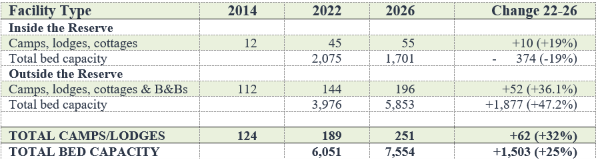
The only reason that total bed capacity in the Reserve has reduced is because Keekorok is temporarily closed.
We had a total of 6,606 paying visitors in September, up from 6,227 last year, and yet the revenue was down by 10% on last year. Numbers for October are well down on September, but so far we are not seeing any significant changes on previous Octobers
Security
October was another record month for arrests, smashing the record set in September and more than doubling the record set last year. There were 145 arrests; 1,893 snares were collected; 154 wildebeest rescued, together with 13 zebra, three topi and an impala; 15 wildebeest butchered, with two zebra, two topi and two buffalo; a total of 22 wildebeest were found dead in snares. The Table below provides a summary of the past four months.

The Oloololo team joined forces with Anne Kent-Taylor’s scouts and recovered 94 snares on the 30th September. Our Iseiya rangers recovered 42 snares on the same day, 14 wildebeest were rescued and three were found dead in snares. The Ngiro-are team managed to arrest one person and one of our rangers was injured by a machete as he tried to apprehend the poacher.
The Iseiya team crossed over into the Northern Serengeti on the 2nd for a four day patrol and managed to arrest four people the same day, they followed it up with another five that night. The following day they caught six people and that night another seven. They continued their patrol and caught a further eight people on the 4th, with four more that night. On the fifth, their last day our rangers managed to arrest two people during the day and six that night. In all 42 people arrested in four days and nights. The people across the river hardly use snares, only 32 were collected, with one wildebeest rescued. They tend to hunt with dogs and immobilize animals with a cut across the spine. Our rangers said that too many animals had been killed to count – anything from 50 -100.
While the Iseiya rangers were across the river, our Ngiro-are team concentrated in the Lemai Wedge and managed to collect 202 snares and arrest five people. Six wildebeest were rescued, three had been butchered, as was one topi.
Our teams switched places, with the Ngiro-are team crossing the river and the Iseiya team concentrating in the Lemai Wedge from the sixth. The team across the river caught two people that first day and then 18 people on the 8th – six during the day and 12 that night. They continued their patrol and caught another eight on the 9th (three during the day and five that night), four on the 10th – one during the day and three at night. They caught one person on the morning of the 11th.
The Iseiya team managed to collect 626 snares and arrest one person in that time. Twenty nine wildebeest, 9 zebra were rescued, five wildebeest had been butchered and two were found dead.
Twelve people were arrested on the 12th by the Iseiya team, all in the North Western corner of the Serengeti. A further ten people were arrested on the 13th and then seven more on the 14th and early morning of the 15th, during the same extended patrol. During that time the Ngiro-are team collected 190 snares , rescued 38 wildebeest, and one impala, found two dead wildebeest and where seven had been butchered in the Lemai Wedge.
We continued to collect snares and an the 16th the Ngiro-are rangers collected 161; 16 wildebeest were rescued and 12 were found dead in snares. The Oloololo team joined forces; with Anne Kent-Taylor’s group and managed to collect a further 85 snares; 17 wildebeest, a zebra and a topi were rescued, whilst four were found dead. Two poachers were arrested that day, one by the Iseiya team and one by the Oloololo/A K-T team.
Our rangers collected 295 snares between the 17th and 19th, 28 wildebeest were rescued, as were two zebra; 12 wildebeest and one buffalo had been butchered and eight wildebeest were dead.
The wildebeest started moving away after the rains mid-month and we saw a significant drop in poaching from around the 20th. However, we did managed to arrest two people on the 20th at Lempise as they came to check snares – 19 were recovered. Sixty six snares were collected between the 21st and 23rd, four wildebeest and a zebra were rescued and three wildebeest were found dead. One person was arrested at Lempise and the Iseiya rangers arrested five more in the Northern Serengeti. They arrested nineteen more the following three days – eight during the day and eleven at night, all between Serengeti Ndogo and Machechwe.
The Ngiro-are rangers collected another 60 snares and rescued a topi on the 25th and 26th and three more on the 27th. The Iseiya rangers returned across the river after a two day break and arrested four more people near Machechwe. On the same day the A K-T/Oloololo team collected 12 snares and rescued a topi.
The Ngiro-are team crossed the river and arrested one of two people who had killed a buffalo on the 29th. They also collected five snares.
Our management accounts for the first quarter if the financial year are summarized below in Kenya Shillings[1].
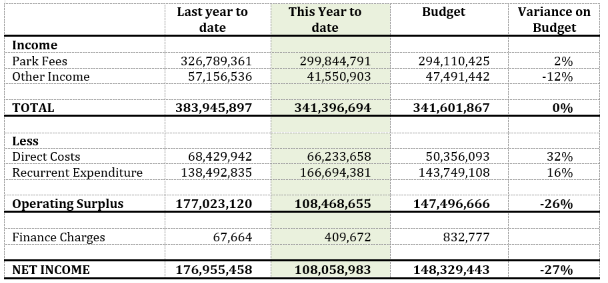
[1] 1 US$ = Ksh 129 at the current rate of exchange
We had anticipated a drop in revenue this year and, to date, we are almost exact in our revenue projections. However, we were out on commissions to KAPS, recorded under direct costs, and our repairs to infrastructure were significantly higher than budgeted for. Our major expenses were in renovating staff housing, preparing for El Niño and constructing a drift over the Sabaringo Lugga. We don’t anticipate any major expenses going forward – apart from the Visitor Centre – and expenditure on repairs will reduce going forward.
Our big concern for the remainder of this year will be whether we can meet the financial obligations relating to completing the Visitor Centre, any further drop in our projected revenue will definitely cause problems. There are three factors that could impact revenue, all of them very real. Ebola, the first cases have been seen in Kenya; the effect of the projected super El Niño; and concerns over the elections next year – all could have a negative impact on tourism.
Report on focus for October.
We completed a new road linking the existing Maji Machafu road with the main Mara Bridge/Oloololo road near the 3 Km road to the border.
We replaced the borehole pump at Little Governors after flushing the borehole. This now works well after months of problems.
We opened the new drift over the Sabaringo near the Kichwa airstrip and completed two new drifts on the lower road to Mara Bridge, there is only one remaining, over Maji Machafu.
Work on the Visitor Centre is progressing well and most of the rammed earth walls over the exhibition area have been completed to the first level.
We have nearly completed the first phase of renovating staff houses at Serena. The modifications have allowed us to add another five rooms and give each person private access to their own room. We have also increased the number of toilets and showers for staff.
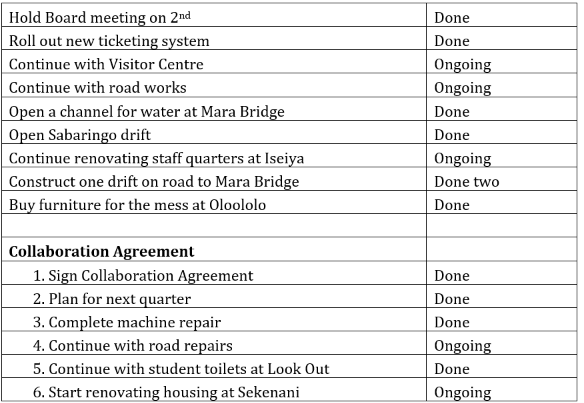
Focus for November 2026
Support Maa Cultural Week;
Continue with Visitor Centre;
Construct small market for bead sellers;
Continue with road works; and
Complete Phase I housing renovations at Serena;
Work on Collaboration Agreement
Finalize Collaboration Agreement;
Provide fuel for Main Reserve;
Hold Maa Cultural Week, 10-14th;
Repair roads from Sekenani to Olololamutia and Talek;
Complete student toilets at Look Out; and
Complete renovating 12 houses at Sekenani.