GENERAL
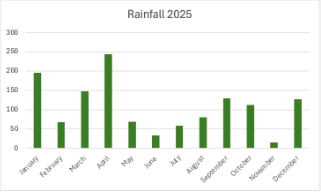
We had 1,280.11 mm (51.2”) of rain in 2025, continuing the above average rainfall we have been experiencing for the past few years. This above average rainfall has had a major impact on the vegetation – not all for the good. Unpalatable grasses and invasives have proliferated; hundreds of trees have died from waterlogging and the predominant grass – Themeda (red oat grass) has been replaced by grasses more suitable to the high rainfall. However, it looks like there has been a significant change in the weather, November was exceptionally dry and January has been relatively dry as well (80 mm against 190 mm last year) – are we in for a major drought? The Mara River is already approaching record lows.
We held our Annual Greater Serengeti Society meeting in Lobo, Northern Serengeti from the 9-11th. These meetings are always extremely interesting and raise so many issues of great relevance and importance to the long-term sustainability of the Serengeti/Mara ecosystem. One issue that is of great importance and a particular interest of mine is the effect of tourism on The Migration. A few numbers that are both interesting and alarming.
Wildebeest avoid buildings for up to six kilometers, 79% of the Serengeti/Mara is within six kilometers of a building/camp/lodge.
Wildebeest are spending 24 days a year LESS in the Mara than 20 years ago;
Only half the number of wildebeests now visit the Mara;
Tourism infrastructure has increased in the Serengeti/Mara by 783% since 2006;
There were 95 tourist facilities in the Mara in 2012; 175 camps in 2024 and 183 camps in 2025. Much of the new development is happening within the Reserve, despite a Management Plan and moratorium.
The figure below shows the camps and lodges in the Mara and surrounding conservancies; you will note that more than 90% of them are built along water courses and the main rivers. What this map does not show is the sprawling development of towns, private houses, schools, churches and fences. It should be noted that NO camps are built along rivers in the Serengeti.
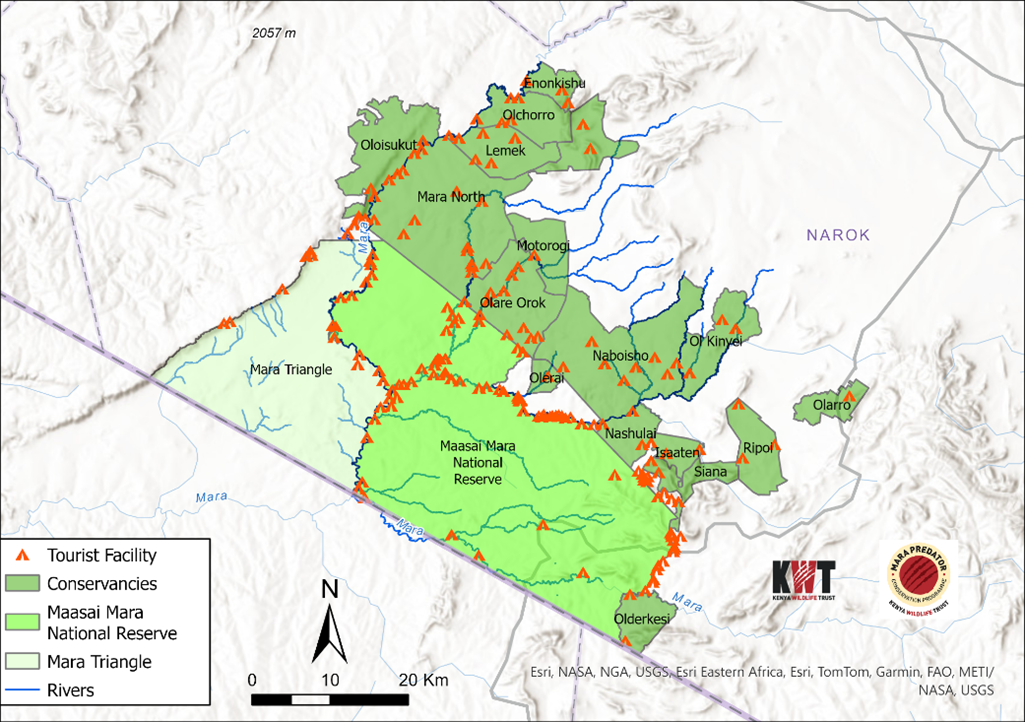
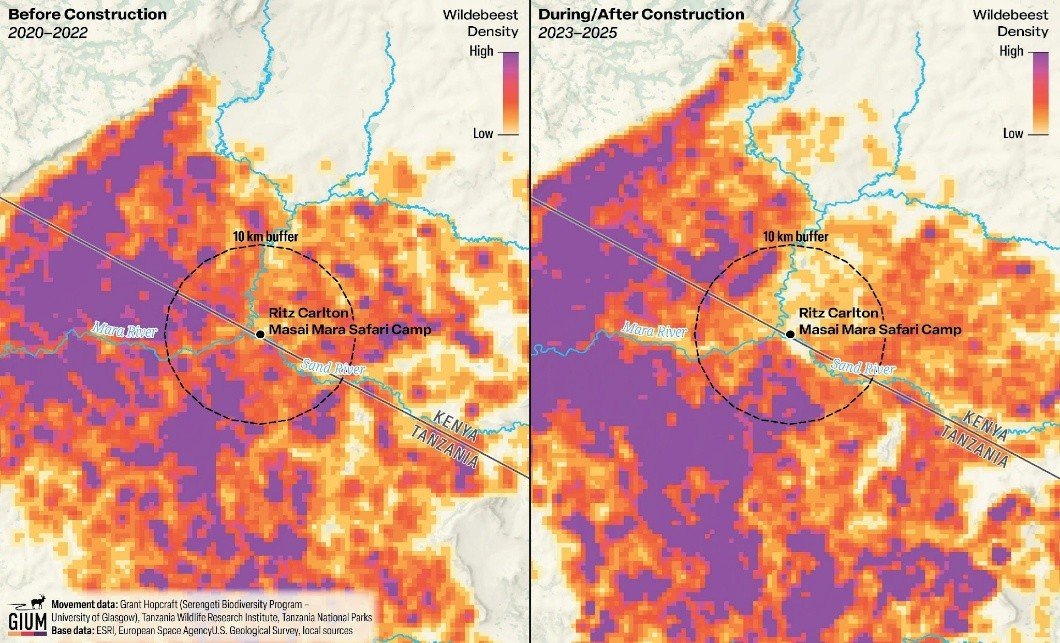
What is the effect on wildlife of these camps, and development along water courses and rivers? The answer lies in the points listed above. These camps and lodges are severely impacting migration. The only place Wildebeest can cross the Sand River into the Mara is where Sand River crosses into the Serengeti. Camps, not only Ritz Carlton, have blocked off a major crossing point. Let’s go further North - the Talek has become a physical barrier. All the earlier maps show the migration going as far as Mara North and the conservancies, that has not happened for five years or more. We have effectively halved the dispersal area for The Migration in since 2020. The maps below amply show how the migration no longer crosses the Talek. It also shows how the wildebeest have avoided crossing close to the camps situated along Sand River. The long-term implications are huge, a further reduction of the migration into the Main Mara – far fewer crossings. This past year the migration only remained in the Main Reserve for a month, there were only about 14 days of crossings, down from 29 the previous year and from 50 days in the past. No animals now cross back from the Triangle into the Main Reserve, what was known as Main Crossing above Serena has next to no crossings. The majority of crossings now take place in Tanzania. The very spectacle that brings tourists to the Mara is being destroyed. Thank goodness we still have the Triangle, where the wildebeest come in good numbers and stay at least three months
We purchased three drones; a number of our staff have been trained and licensed to operate them. One of the drones will be used by our security team, it is fitted with a thermal camera, the others will be used for anti-harassment and rhino monitoring.
We held a meeting with KAPS’ senior management on the 26th to discuss the findings of a systems audit conducted by M/s Nicholas and Co. The major concerns revolved around tickets being exited before the clients had left and inadequate controls on entry and re-entry. KAPS are reviewing and upgrading their system and should have something in place by April.
COLABORATION AGREEMENT
We held our quarterly planning meeting on the 16th. Despite wanting to cut back on projects we have ended up with a very busy work program. We will complete the ongoing projects:
The toilets at the Keekorok airstrip;
Renovating housing and offices at Sekenani;
The ranger post at Ngama Hills;
Providing fuel.
We will start on:
A shelter for bead sellers at the Keekorok airstrip;
A new revenue office at the Keekorok airstrip;
A students’ toilet at the Keekorok airstrip;
Renovating the toilets at the Olololomutia gate;
Public toilets at Simba;
Re-roofing Talek Gate;
Demolishing and re-building a house at Sekenani;
Fencing the entire staff compound at Sekenani; and
Constructing two new game viewing roads.
We continue to help the County Government maintain their machinery for work outside the Reserve. We have purchased 180 tyres and overhauled at least five grader engines and continue to provide fuel. So far, we have spent Ksh 30,036,621 on this additional work. Nearly all the machines are now operational.
STAFF
We held our annual staff transfers on the 15th. The exercise went very smoothly, and the staff have now settled in their new stations.
WILDLIFE
The lion cub we rescued late last month on Mara North was successfully reunited with its mother on the 4th. The cub had been badly injured by an unknown male, it was darted, treated and brought to the Conservancy holding pen. We fed and treated it until it recovered. The male moved on and so we reunited it with the pride.
Dr Ashif treated a bull elephant with an arrow imbedded in its front right foot on the 4th, he removed the arrow and treated the bull. He treated another elephant a few days later on Mara North for a similar injury.
Another very alarming finding reported at the Serengeti meeting was the decline in a number of species, raptors being amongst the most affected. The Figure below should give everyone great concern.
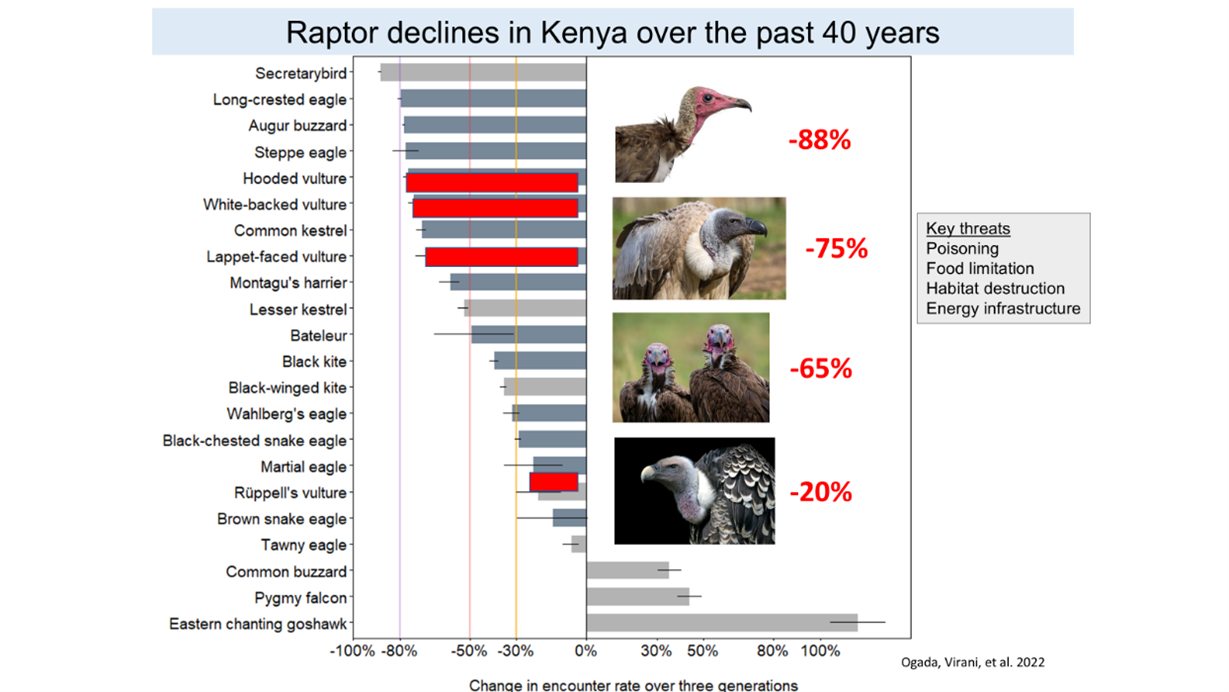
The poisoning of wildlife is a major issue, numerous lions and hyena have been poisoned in the Mara ecosystem in the past year. There was a report of six lions and 34 vultures poisoned around Amboseli as we were at the meeting.
Professor Joseph Ogutu gave a Podcast this month that should raise the alarm, not only about raptors and predators but of the very significant wildlife declines in the Mara ecosystem (The Sacred Nature Iniative). Elephant and rhino have recently increased, mainly because of the focus on protecting them. However, virtually all wild herbivore species have declined by 80-90% in the past 50 years (Cattle have declined by about 10% but sheep and goats have increased by 600%). It is easy for people to feel complacent. There seem to be significant wildlife numbers in the Reserve and major conservancies. But the animals are now concentrated in a far smaller area because of human pressure - land sub-division, development and fencing. Even the conservancies are being cut off from the Main Reserve; Naibosho and OOC are virtual islands and Mara North is increasingly becoming one – with development all along the Reserve boundary stretching as far as Musiara from Talek.
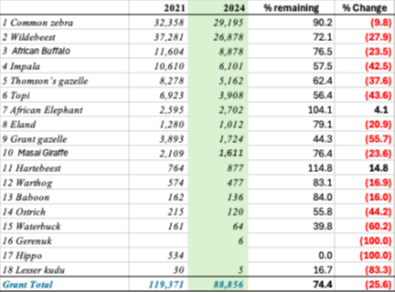
The Table above illustrates the continuing decline in the Mara ecosystem between 2021 & 2024. (Source: Kenya Wildlife Service: National Wildlife Census 2025). Overall, a 25.6% decline in three years from an area that generates tens of millions of US$ each year from wildlife.
Dr Niels Mogensen and others have recently published papers on the effect of tourist camps and cattle on lion conservation in the Mara.
Balancing benefits and burdens: Tourist camps and lion conservation in the Maasai Mara (2025). N Mogensen, C Packer, J-C Svenning, I Amoke and R Buitenwerf . Conservation Science and Practice 70210;
Human-driven landscapes of fear for Africa’s largest terrestrial predador in humen-used conservation landscapes (2025). N Morgensen, C Packer, J-C Svenning, K Sankan and R Buitenwerf. Elsevier, Biological Conservaction.
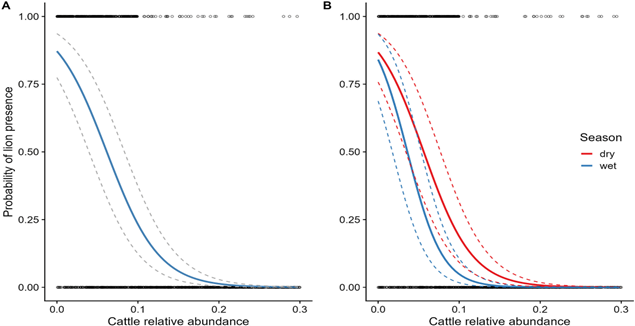
Both papers amply illustrate the negative effect of both tourist facilities and cattle concentrations on lion distribution. The figure below illustrates the effect of cattle on lion distribution (Mogensen et al, 2025).
Lions killed a young female leopard near Mara Serena on the 28th, she was caught out in the open and killed about 30 meters from a tree.
A thirteen-year-old boy was killed and partly eaten by a lion near Ngiro-are at 5.00 pm on the 30th, he and two companions had stopped to eat wild fruits along the escarpment when returning cattle to their homestead.
TOURISM
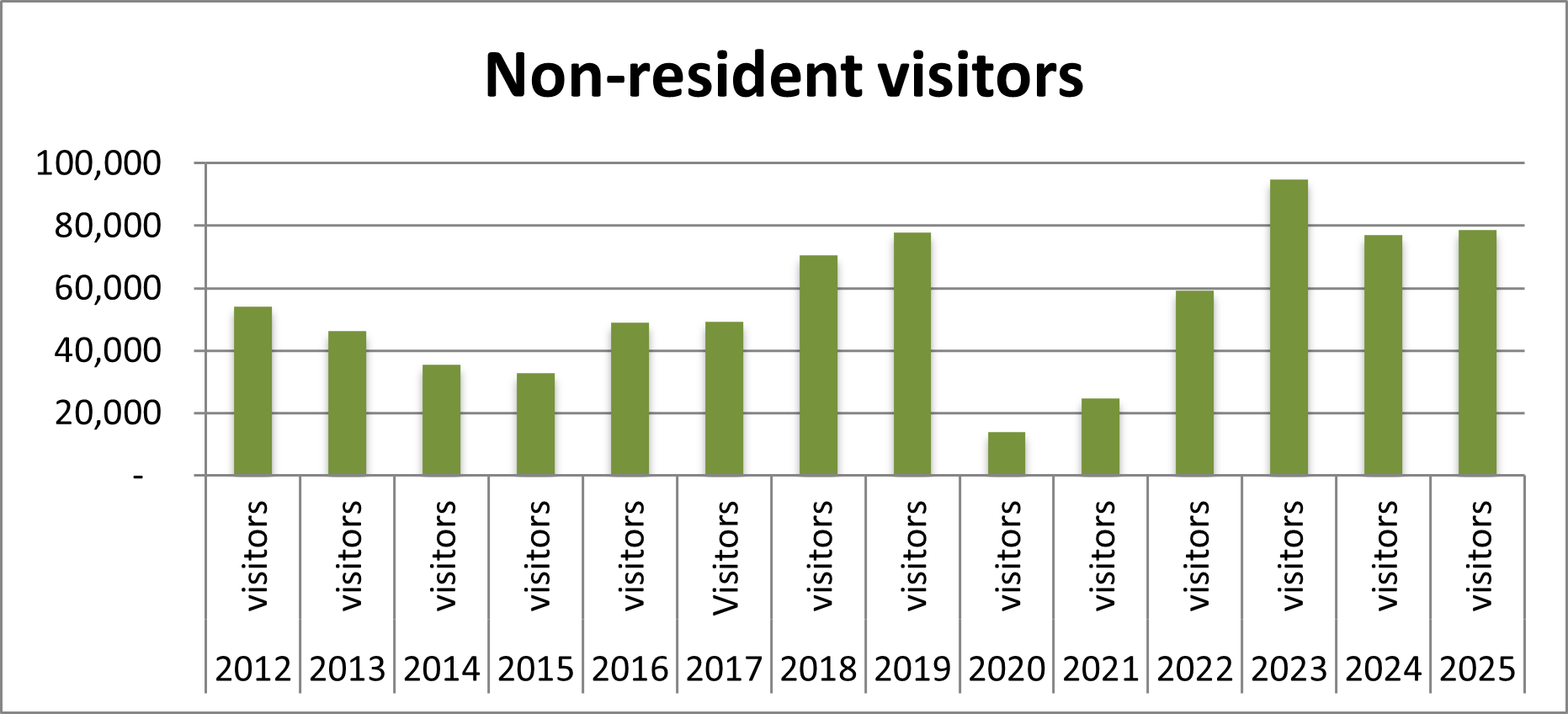
We had a total of 138,539 visitors to the Triangle, of which 78,523 were non-residents. This is slightly higher than 2024 (129,410 and 76,905 respectively) but well below 2023 .
Little Governors remains closed for a major refurbishment and Mpata Club is also undergoing a complete makeover. Both properties are planned for re-opening in June, in time for the high season.
SECURITY
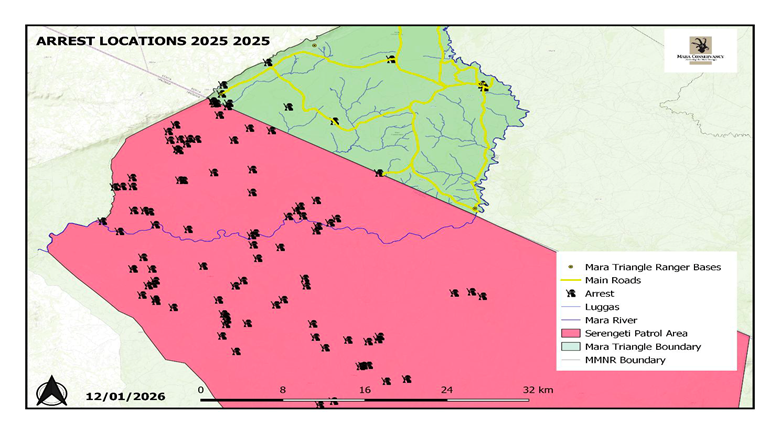
We managed to arrest 270 poachers in 2025 and recover 1,600 wire snares. The map below provides a good representation of the area covered by our patrol teams and the extent of poaching in the Northern Serengeti and Mara.
This month we have arrested 18 poachers, 10 of them were well-known poachers and wanted by TANAPA. This time of year, the poachers focus on hippo and buffalo but also hunt with dogs and torches at night. We know of at least five hippo and two buffalo that were killed. Only four snares were recovered.
The rangers found four snares on the first and found one dead zebra.
One of our anti-harassment rangers reported seeing poachers late evening on the 6th. He called the rangers. They found a hippo that had just been speared and managed to arrest one person, the rangers set an ambush and arrested three more people. One person escaped. They had arrived two days previously and this was their first hunt. All four were taken to Lolgorien for prosecution.
One hippo was found butchered along the Mara River in Tanzania on the 10th and then on the 11th our rangers found where a buffalo had been speared, and all the meat taken near Ol Donyo Olpaek on the Kenya/Tanzania border. One spear was found. That same day the Iseiya rangers crossed the river on an extended patrol and managed to arrest three people. In the first instance they arrested one person who was hunting with dogs and then later they caught two more people who were hunting hippo.
A guide from Alex Walker’s camp in the Lemai Wedge reported seeing a poacher carrying meat on the 13th. Our rangers responded and caught the person, he was one of four who had killed a hippo just upstream from. Ritz Carlton on the Sand River in the Main Reserve. One other hippo was found butchered near the Singita camp in the Lemai Wedge.
We set ambushes near Ol Donyo Olpaek following the buffalo killing on the 11th and on the night of the 14th we succeeded in arresting five people from a group of seven. The rangers watched them from a distance as they approached a buffalo herd. They were caught before they could kill anything. These were almost certainly the same people who had killed the earlier buffalo on the 11th.
One hippo was found butchered between Saiyari and Kogatende on the 19th and the following day one poachers was arrested by a joint team, as he and his companion hunted near Kokamange in the Lemai Wedge.
The Ngiro-are team set an ambush on the 21st and managed to arrest three people who had been hunting near Nyakita Pembe with dogs, they had killed three Thompson’s gazelle by the time they were caught.
Two people were arrested by the Ngiro-are team near Lempise in the Lemai Wedge on the 26th, they were hunting with dogs.
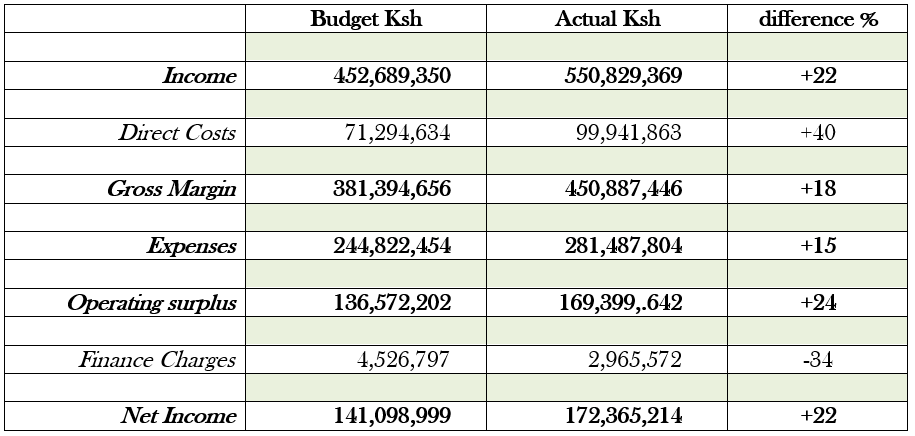
Direct costs relate to the KAPS commission for the whole amount collected, not just the Mara Conservancy share, and the purchase of promotional materials. Costs directly attributed to staff make up 49% of our expenditure, other major expense items include support to the community 14% and construction/repairs and maintenance 16%. Our major expense item in the coming year will be the Visitor Centre – budgeted at a million dollars (Ksh 130,000,000). We will renovate all the old staff housing but have no other major construction projects.
REPORT ON FOCUS FOR JANUARY 2026
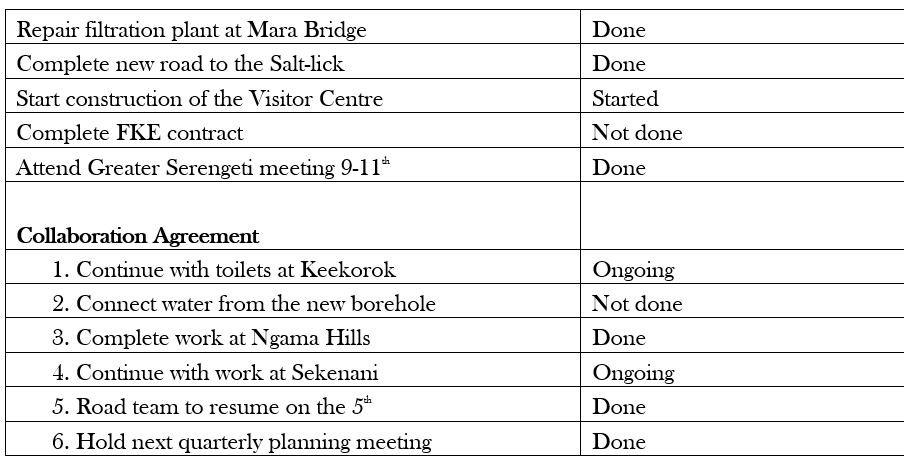
We have completed work on the new road to the salt-lick.
We concreted the drift below Serena.
We concentrated on minor repairs at Oloololo and Ngiro-are.
Work started on the Visitor Centre, one part of the foundation was obviously an underground stream at some point and we had to dig down nearly 10 meters to hit firm ground. This was then filled with rock and hardcore to bring it up to the same level as the main foundation. This has now been done and the ground leveled adequately for the contractor to start construction
FOCUS FOR FEBRUARY 2026
Hold Board meeting on the 20th;
Continue with road works;
Plan on building accommodation for GSU at Oloololo;
Concrete army drift; and
Continue with Visitor Centre.
Work on Collaboration Agreement
We have virtually completed work at Ngama Hills;
We have planned a new game viewing road in the Main Reserve;
Demarcate and start constructing new road;
Continue with renovations at Sekenani;
Maintain Ol Kiombo and Keekorok airstrips;
Complete toilets at the Keekorok airstrip;
Start on women’s shelter at the Keekorok airstrip; and
Connect water at Keekorok airstrip.